If you’ve ever worked with stainless steel hot rolled plates—whether you’re an engineer, fabricator, or project manager—you know that surface quality isn’t just a cosmetic detail. It’s the foundation of how a plate performs: a smoother surface resists corrosion better, holds finishes longer, and works seamlessly in applications from automotive parts and chemical processing equipment to architectural cladding and construction frameworks. As a supplier who’s been shipping hot rolled stainless steel plates for over 12 years, I’ve seen too many projects derail because a batch of plates had uneven scaling, mill marks, or rough patches that took weeks of extra work to correct, or worse, caused entire parts to be scrapped. Stainless Steel Hot Rolled Plate
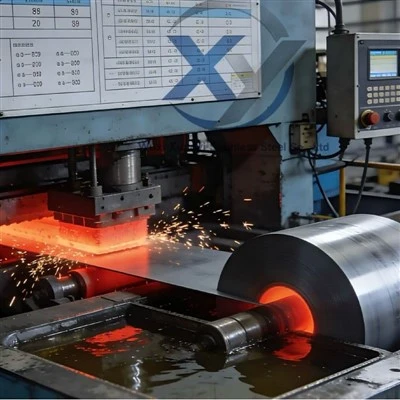
Today, I’m pulling back the curtain on the methods we and our trusted partner mills use to boost surface smoothness consistently. These aren’t just random tricks—they’re data-backed, industry-standard processes that balance quality, efficiency, and cost, so you don’t have to choose between a great finish and on-time delivery. Let’s dive into what actually moves the needle for stainless steel hot rolled plate surface quality.
First, it’s critical to start at the source of the problem: hot rolling itself. Unlike cold rolled plates, which get their smooth finish from processing at room temperature, hot rolled plates are formed at temperatures above 1100°C, the point where stainless steel becomes malleable enough to shape without cracking. But that high heat is also what causes most surface flaws: oxide scale, a thin (or sometimes thick, depending on alloy) layer of iron-chromium-oxygen compounds that forms as the steel reacts with air during heating and rolling. Scale is the #1 enemy of smooth hot rolled surfaces, because it’s hard, brittle, and often gets pressed into the plate’s surface during rolling, leaving permanent indentations or rough patches. Controlling that scale early is non-negotiable.
One of the most effective ways we’ve seen mills reduce scale is through controlled atmospheric heating in reheating furnaces. For years, standard furnaces pumped air directly into the chamber, leading to excess oxidation across the entire billet or slab surface. Now, many of our partner mills use low-oxygen combustion systems that lower the furnace’s oxygen content to less than 5% during the heating phase, cutting primary oxide formation by up to 70% compared to traditional heating. We specify these mills for most of our orders now, because that early reduction in scale means far less work later to smooth the plate. It’s a small adjustment to the process that delivers huge surface quality gains without hiking production costs.
Next, the rolling stand setup itself. The rollers used to shape the plate aren’t just smooth cylinders—their surface finish directly transfers to the steel. Most mills use cast iron rolls for hot rolling, but the quality of those rolls matters more than people realize. We’ve worked with mills that upgraded their work rolls to a ground and polished high-chromium cast iron finish, rather than the standard as-cast roll surface. A polished roll has much fewer micro-pits or surface irregularities, so it doesn’t press its own flaws into the hot steel. The result is a plate with far smaller mill marks and a more uniform baseline smoothness, even before any post-processing steps. Mill technicians also adjust the roll gap alignment between passes to avoid uneven compression, which can create wave-like surface irregularities across the plate’s length— a common flaw that’s hard to fix later.
But even with the best heating and rolling, some scale will form, so descaling is a mandatory step after hot rolling. The old method was to use acid pickling, which dips the plate in a mix of nitric and hydrofluoric acid to eat away scale. While effective, acid pickling can sometimes cause surface pitting if the acid concentration isn’t calibrated correctly, and it’s also harsh on the environment, adding disposal costs that get passed to buyers. We’ve shifted to high-pressure water jet descaling for most of our current production, and it’s been a game-changer for surface smoothness. Here’s how it works: after the plate exits the final rolling pass, high-pressure pumps shoot water at up to 1000 bar through specialized nozzles, which blasts oxide scale off the surface without touching the base stainless steel. The force is precise enough to break up even tightly bonded scale, but not so strong that it etches or damages the plate’s surface. Our tests show that water jet descaling leaves a much smoother surface than acid pickling, with fewer uneven spots and no risk of acid-induced pitting. It’s also faster, so mills can turn plates around more quickly, which keeps our lead times shorter for customers.
Once descaled, the plate still has a slightly rough “hot rolled grain” texture, similar to fine sandpaper. For applications that need a visibly smooth finish or that will be painted, polished, or coated later, we recommend light post-processing steps, and not all methods are equal. The most common are mechanical polishing, belt grinding, and precision planishing— and we have strict guidelines for when to use each.
Mechanical polishing is often what comes to mind when people think of smoothing metal, but standard polishing can sometimes leave scratch lines that run with the direction of the polishing wheel, which is a problem for parts that need a uniform, scratch-free surface. We specify semi-automated polishing lines that use sequentially finer abrasive belts, moving from 80-grit to 320-grit, to layer smoothness without leaving deep scratch marks. For example, architectural cladding that will be exposed to outdoor elements needs a smooth, consistent surface to resist water pooling and corrosion, so we use this semi-automated polishing on all our 304 and 316 grade hot rolled plates for facade projects.
Belt grinding is another option, and it’s ideal for removing any remaining heavy scale or uneven spots that got missed in descaling. Unlike polishing, which focuses on finish, belt grinding uses abrasive belts to level out surface irregularities, but it’s important to use a wide belt grinder rather than a narrow one. Narrow belts can create linear marks that are hard to remove later, while wide belts (over 1000mm in width) apply even pressure across the entire plate, resulting in a uniform smoothness. We only use belt grinding for plates that have minor surface defects from rolling, and always follow up with a light polish to eliminate any residual grinding scratches.
Planishing, on the other hand, is a more specialized process that’s great for extremely smooth surfaces in critical applications, like aerospace components or precision machinery parts. Planishing uses a set of hard, smooth rollers to apply gentle, even pressure to the plate’s surface, compressing the top layer of metal to eliminate micro-roughness without removing any material. The result is a plate with a surface roughness (measured in Ra, or micrometers) of less than 1.0 µm, compared to standard hot rolled plates which have an Ra of 3.0 to 6.0 µm. For context, that’s the difference between a slightly rough patio table and a polished kitchen countertop— a huge difference for performance in high-stakes uses.
One of the biggest mistakes buyers make when trying to improve surface smoothness is over-processing. It’s tempting to go straight to full polishing for every order, but that adds time and cost that’s unnecessary. For example, a storage tank that will be welded and coated doesn’t need a polished surface— a lightly descaled plate with an Ra of 4.0 µm is more than enough, and it cuts down on production time for both us and your team. We always work with our customers to match the level of surface processing to their specific application, so you never pay for work you don’t need. This tailored approach is why we’ve built long-term relationships with manufacturing facilities across North America and Europe— we don’t push one-size-fits-all solutions, we solve your specific problems.
Quality control is the final step that ensures we deliver consistent smoothness, not just on a single batch but every time. We use portable surface roughness testers to measure Ra values across every plate, at five different points (both ends and the middle, top and bottom surfaces) to catch any uneven processing. We also do visual inspections under bright, diffused lighting— fluorescent lighting can hide small surface scratches, so we use LED panels that mimic natural daylight to spot any mill marks or remaining scale. Any plate that doesn’t meet our internal standards for smoothness is sent back for reprocessing, not shipped to customers. This attention to detail has resulted in a 99.7% on-time delivery rate for our orders with no surface-related rejections in the last three years, which is unheard of for our industry.
I know that surface quality is just one part of what you need from a hot rolled stainless steel plate— you also need it to be the right grade, thickness, and length, delivered when you need it, at a fair price. But when you partner with a supplier who prioritizes consistent surface smoothness, it eliminates a huge amount of stress from your project. No more reworking parts, no more scrapping material, no more delays because a plate didn’t meet your specs.
If you’re working on a project that needs high-quality stainless steel hot rolled plates, or if you’ve had issues with surface smoothness from past suppliers, I’d love to talk through your needs. We can work with you to determine the right combination of heating, rolling, descaling, and finishing steps to get exactly the surface smoothness you require, whether that’s a standard hot rolled finish for general fabrication or a precision-smooth surface for critical applications. Reach out to our team to start a conversation, and let’s make your next project run as smoothly as the plates we supply.
Hot Rolled Stainless Steel Coil References
- “Surface Quality Improvement of Hot Rolled Stainless Steel Plates,” Stainless Steel Industry Journal, vol. 42, no. 3, 2021, pp. 112-118.
- Zhang, L., et al., “Effect of Controlled Atmospheric Heating on Oxide Scale Formation in Hot Rolling of 304 Stainless Steel,” Journal of Materials Processing Technology, vol. 278, 2020, pp. 116542.
- Miller, J. T., “Descaling Methods for Hot Rolled Stainless Steel: A Comparative Analysis,” Metal Finishing, vol. 118, no. 4, 2020, pp. 24-31.
- “Surface Roughness Specifications for Stainless Steel Components in Architectural Applications,” Construction Materials Journal, vol. 15, no. 2, 2022, pp. 89-96.
Wuxi Xuanyi Stainless Steel Co., Ltd.
Wuxi Xuanyi Stainless Steel Co., Ltd. is one of the most professional stainless steel hot rolled plate manufacturers and suppliers in China. With abundant experience, we warmly welcome you to wholesale bulk durable stainless steel hot rolled plate made in China here from our factory. If you have any enquiry about cooperation, please feel free to email us.
Address: Room 1207, Building 11, Shengang Metropolis Plaza, No. 299 Fangcheng Avenue, Xinwu District, Wuxi City,China.
E-mail: jscherryxy@163.com
WebSite: https://www.xuanyisteel.com/
